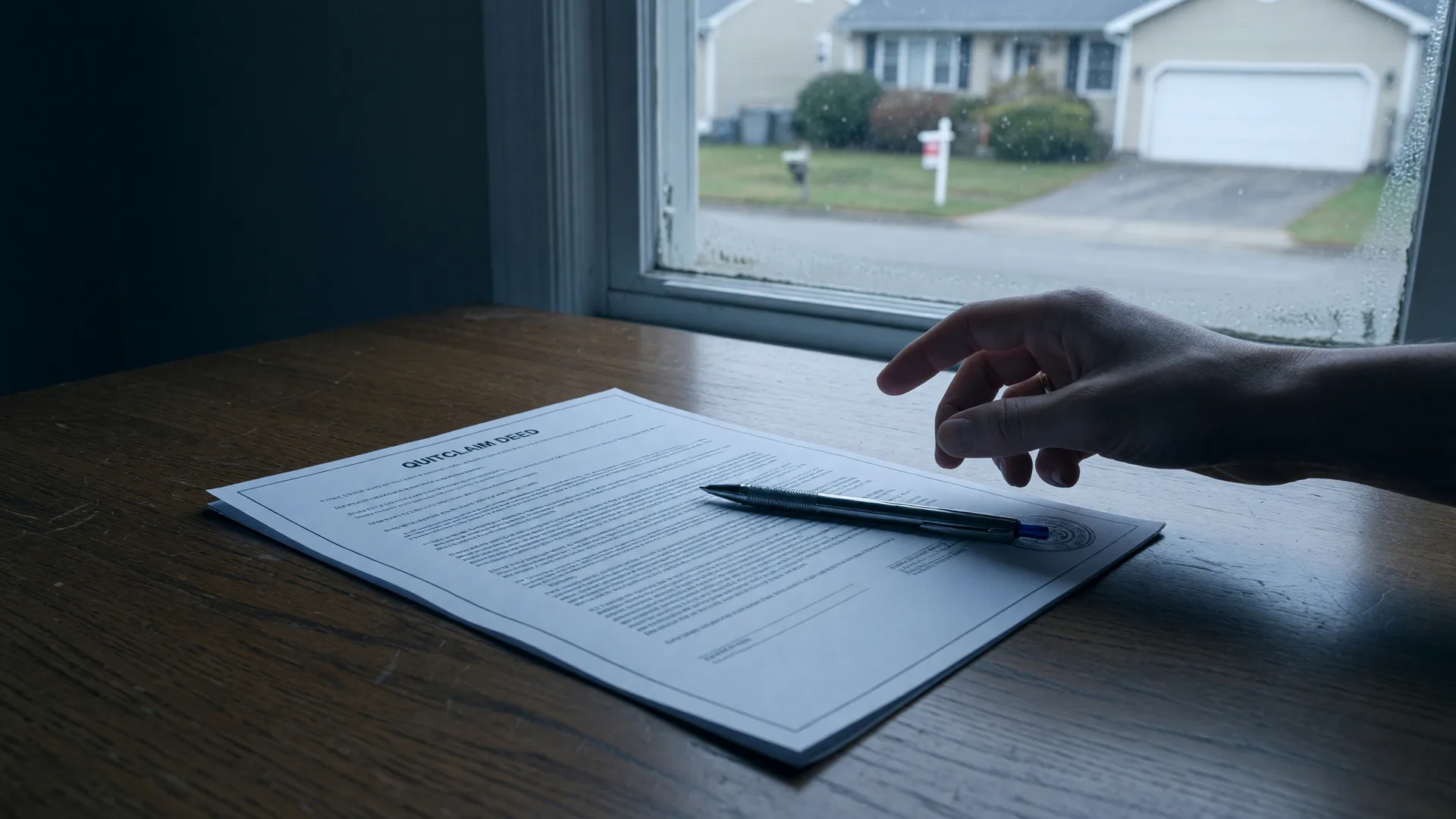
A father in another state gives his adult daughter a power of attorney so she can sign the closing documents on his house. The document is properly notarized, looks official, and names her as attorney-in-fact with authority over his real property. The title company still says no. This happens far more often than buyers and sellers expect, and the reason is not that the company is being difficult. It is that the title company is being asked to insure a transaction where the most important person, the owner whose deed and mortgage are being signed, is not the person actually signing. This article explains why a valid-looking power of attorney gets rejected at a real estate closing, what underwriters require before they will insure one, what Nevada law adds to the list, and what to do instead.
None of this is legal advice, and every state and every title underwriter applies its own rules. But the underlying logic, that a title company gets to choose whether it will insure a POA signing, is the same everywhere, and understanding it is the difference between a smooth closing and a blown one.
Why the Title Company Gets to Say No at All
A title company does not merely notarize documents. It issues a title insurance policy, which means it promises to pay if a hidden problem in the chain of title damages the new owner or the lender. A power of attorney sits at the very center of that promise. If the POA is a forgery, if the principal was coerced or incompetent when they signed it, if the principal has since died, or if the document did not actually give the agent the specific power being used, then the deed or mortgage signed under it can be invalid, and the policy can have a claim against it.
Title underwriters therefore treat POAs as high-risk documents and authorize their use sparingly, based on necessity rather than convenience. That phrase, "necessity rather than convenience," is worth remembering. A title company is not refusing to accept a POA to inconvenience you. It is refusing because accepting it creates a risk the company does not have to take, and the law lets it decline. When an underwriter does accept one, it is doing so on a set of conditions designed to make the risk insurable, and those conditions are strict.
Six Reasons a Valid-Looking Power of Attorney Gets Rejected
Most rejections fall into one of six categories. Check your document against this list before you ever set a closing date:
- It does not specifically identify the property or the transaction. A generic grant to "handle real estate transactions" or "sell my property" is usually too vague. The document needs to name the parties, the exact property by legal description, and the specific power being exercised, such as the power to convey or encumber that specific parcel. A special or limited POA written for the one transaction is far more likely to be accepted than a general one.
- It is too old. Underwriters are uncomfortable relying on a POA executed long before the closing. As a practical matter, many reviewers disfavor documents more than about a year old, and some will require a signed affidavit that the POA is still in force once it is roughly 30 days old. The newer the document, the easier the review.
- It is a general or internet form that lacks the specific powers state law requires. Some states require a POA that conveys real property to contain specific enumerated language or to be on a form that tracks the state's statutory form. A stationery-store or downloaded template that is missing that language may be perfectly valid between the principal and the agent and still be uninsurable at a closing.
- It was not acknowledged in recordable form. To be relied on for a deed, the POA must be signed and dated by the principal and acknowledged before a notary in the form the county recorder will accept. A witnessed-only document, or one with the wrong notarial certificate, cannot be recorded and generally will not satisfy an underwriter.
- The principal has died or lost capacity. A power of attorney is void when the principal dies, full stop. And unless the POA is durable, it also lapses when the principal becomes incapacitated. If the owner died after signing the POA, the document is worthless for the closing, and the transaction must be handled through the estate instead. If the owner is alive but no longer competent, only a durable POA, or a court-appointed conservator or guardian, can act.
- It is revoked, or the identity and authority cannot be verified. A principal can revoke a POA at any time, and in Nevada a recorded POA is not treated as revoked until the revocation is also recorded. The title company will want proof the authority still exists, which usually means an affidavit from the agent confirming the principal is alive, is not incapacitated, and has not revoked the document.
What Underwriters Require Before They Will Insure a POA Signing
When an underwriter does accept a power of attorney, it typically requires a checklist that goes well beyond "it was notarized." Expect most or all of the following:
- The POA must be in writing, signed and dated by the principal, and acknowledged in recordable form, not just witnessed.
- It must be specific: it should name the agent and the principal, identify the exact property by legal description, and expressly grant the authority to convey or encumber that property for this transaction.
- It must be recorded in the county where the property sits, so that the title examiner can see it in the chain of title and so that a later revocation shows up in the same records.
- The agent must provide an affidavit that the principal is alive, is not incapacitated, and has not revoked the POA, and that the agent has no knowledge of facts that would invalidate it. If the POA is not durable and the principal's capacity could be questioned, that is a problem, not a detail.
- If the principal may be incapacitated at the time of signing, the POA needs durable language, the kind that survives incapacity.
- Lender and investor rules add their own layer. Fannie Mae, FHA, VA, and USDA programs each impose limits on who may sign as attorney-in-fact, and many require the agent to have a familial or fiduciary relationship with the borrower, or to be an employee of the title company. A POA that satisfies the seller's underwriter may still not satisfy the buyer's lender, and approval by one party does not bind the other.
The practical result is that the title company needs time to get the POA reviewed, recorded, and confirmed, and the lender needs time to run its own approval. A POA that shows up at the closing table is almost always a delay. A POA that shows up a week before closing can often be cleared. A POA that shows up the morning of closing is a reschedule.
What Nevada Adds to the List
For closings in Las Vegas, Henderson, or anywhere else in Nevada, state law adds specific requirements on top of the underwriter's checklist. Under Nevada Revised Statutes Section 162A.480, a power of attorney that gives an agent the power to convey real property must be recorded in the same manner as other real-property conveyances, which means filed with the county recorder in the county where the property is located. Under NRS 111.240, a conveyance affecting real property must be acknowledged to be recorded, which is why the notarial form matters. And under NRS 162A.480, a recorded POA is not considered revoked until an instrument of revocation is recorded in the same office, which is why the title company wants the record checked rather than taking your word that the authority is current.
Nevada is also a community property state, which adds a rule that surprises people even more than the recording requirement: for a community-property home, the non-titled spouse may need to join in and acknowledge the documents too, even if they are not on the deed. And for the growing number of out-of-state and out-of-country principals, Nevada's remote online notarization law, under NRS 240.181 through 240.206, offers a way to get a fresh, validly notarized POA signed when the owner cannot appear in person. That is often the single best fix for the "seller is in another state" problem, and it is worth reading our full explanation of how remote online notarization actually works before you rely on it.
What to Do Instead: The Fixes That Actually Work
If the principal can sign, the simplest answer is almost always to have them sign in person at the closing, or to have them execute a fresh, transaction-specific POA and get it notarized, recorded, and reviewed before the closing date. Everything else is a workaround that trades convenience for risk, and the market prices that risk in time and scrutiny. In practice, these are the options, in order of how smoothly they tend to go:
- Have the owner sign in person. No POA at all is the cleanest file. If the owner can travel to the closing or to a local notary, do that. It is the difference between an ordinary closing and a scrutinized one.
- Get a fresh, specific POA for this transaction. If the owner cannot attend, have them execute a special or limited POA that names the agent, names the property by legal description, and grants exactly the power needed, then notarize it, record it, and give the title company and lender time to approve it. A 30-day-old document written for this deal beats a five-year-old general POA every time.
- Use remote online notarization when the owner cannot travel. Nevada and most states allow a live video notarization, which can get a fresh POA executed and notarized without the owner leaving home. It does not fix an old POA, and it does not replace the recording step, but it is a legitimate way to create a current one.
- If the owner has died, do not use the POA at all. The document is void. The sale has to be handled through the estate, typically by the personal representative or executor under a probate court order, and the title company will want to see the letters of administration or testamentary before it will proceed.
- If the owner is incapacitated and the POA is not durable, talk to an attorney. A conservatorship or guardianship may be required, and that takes a court order and time. This is the scenario where a durable POA, executed while the owner still had capacity, would have saved months.
One more rule that applies to everyone involved, agents included: tell the title company about the POA plan before the offer is even written, not at the closing. The title and lender review can take days, the recording takes additional time, and an agent who flags the POA in the contract period saves a closing date that would otherwise slip. If a transaction depends on a power of attorney, the closing date should be set around the POA review, not the other way around.
The Bottom Line
A power of attorney is void on death, lapses on incapacity unless it is durable, must be specific to the property and transaction, must be acknowledged in recordable form, must be recorded in the county where the property sits, and must be current enough, and verified enough, for an underwriter to insure the deed and mortgage signed under it. Any one of those failures is enough for a title company to say no, regardless of how official the document looks. The practical answer is to avoid the problem by having the owner sign in person when possible, and when that is not possible, to create a fresh, specific, recorded POA early in the transaction, use remote online notarization to get it validly executed, and give the title company and lender time to review it. For agents and escrow officers, the professional habit that saves deals is simple: surface the POA at contract time, order the title work early, and treat the POA review as part of the transaction timeline, not as an emergency to be handled at the table.
A Closing Checklist for POA Transactions
- Tell the title company and lender about the POA plan before the contract is ratified.
- Confirm the POA is fresh (days or weeks old, not years), specific to this property, and signed and notarized by the principal.
- Confirm it is durable if the principal's capacity could be questioned.
- Record the POA in the county where the property sits before closing.
- Confirm the principal is alive, competent, and has not revoked the POA, and be ready to sign an affidavit to that effect.
- Check the buyer's lender program (Fannie Mae, FHA, VA, USDA) for its own attorney-in-fact rules.
- In Nevada, confirm the non-titled spouse will join and acknowledge if the home is community property.
- If the owner has died, route the transaction through the estate and do not rely on the POA.