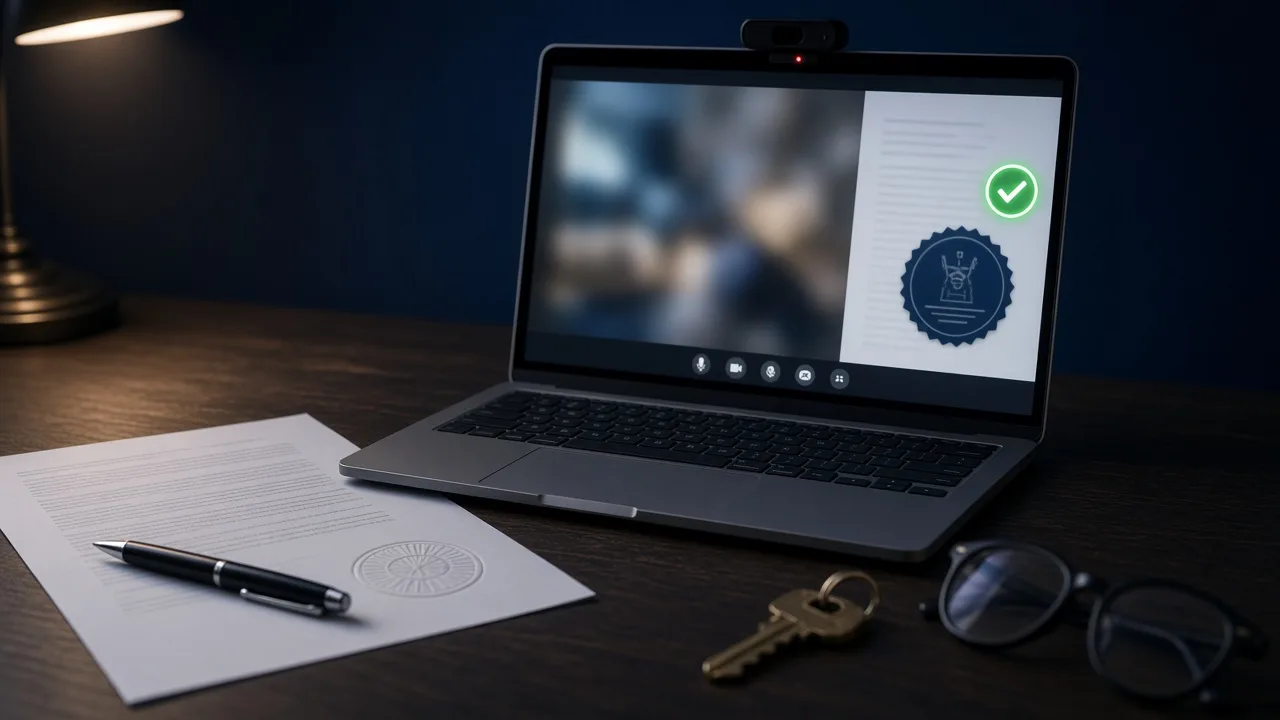
Your title company asks you to sign your deed and closing documents over a live video call with a notary. That is remote online notarization, or RON, and yes, it is legal in Nevada and in the great majority of states. A remotely notarized document carries the same legal weight as one signed in person, but the process is not the same, and a notarization never proves that the person signing actually owns the property. Here is how RON works, how your identity really gets verified, and the questions worth asking before you agree to a remote signing.
First, What Remote Online Notarization Actually Is
RON is a way of performing the notary's job when you cannot be in the same room. Instead of appearing physically before a notary, you appear through a live, two-way audio-video session on an approved online notarization platform. The notary watches you sign the document in real time, verifies your identity through the platform, applies a digital notary seal, and records the whole session.
The steps sound simple, but each one has a purpose:
- Identity verification. Before the session, you upload a current government-issued photo ID. The platform runs credential analysis and, in most states, a knowledge-based authentication check. The notary confirms the results before proceeding.
- The live session. You and the notary connect by video. The notary confirms you understand the document and are signing voluntarily. You sign electronically while the notary watches.
- The digital seal and record. The notary applies a tamper-evident digital seal and certificate, and the audio-video session is recorded and retained along with an electronic journal of the act, usually for years, as required by state law.
One distinction matters before anything else: RON is the notarization step, not the whole closing. The title company still runs the title search, handles escrow and the money, coordinates the lender, and records the deed. Remote notarization replaces only the moment where a notary would otherwise meet you in person.
Is It Legal? Yes, But the Details Vary by State
Remote online notarization is now broadly legal in the United States. The National Notary Association counts 49 states plus the District of Columbia as having permanent RON laws as of 2026, and documents notarized remotely are accepted in all 50 states. The caveat is that not every state with a law on the books has a fully operational program: roughly 42 to 47 states plus D.C. have laws in effect that allow their own commissioned notaries to actually perform RON, while a handful of states enacted laws that are still being implemented.
The state-by-state map has two notable edges. Virginia enacted the first permanent RON law in 2012, so remote notarization has a fourteen-year track record, not a pandemic-era gimmick. California is the holdout: it passed SB 696 in 2023, but full implementation is not targeted until January 1, 2030, with only a limited pilot running in the meantime. And a federal bill, the SECURE Notarization Act, has been introduced in Congress to standardize RON nationwide, but it is not law, so the states still set the rules.
The practical translation: whether a particular remote signing is allowed, which platform can be used, and what records must be kept all depend on the state where the notary is commissioned, the state where the property sits, and the state where you happen to be signing. "It's legal" is the start of the answer, never the whole answer.
How Your Identity Actually Gets Verified
This is the part people are most suspicious of, and it is worth understanding precisely because a notary's core duty is to know who you are. In an in-person setting, a notary can rely on personal knowledge, a credible witness, or an ID check. Remote notarization replaces "standing in front of me" with a layered electronic check:
- Credential analysis. The platform scans your driver's license, passport, or other government-issued ID, checks it for tampering or alteration, and validates the data against issuing-authority records.
- Knowledge-based authentication (KBA). You answer timed multiple-choice questions drawn from public records, the kind of questions only the real person would reliably know.
- Live checks. Many platforms add liveness detection or continuous facial comparison during the video session, so the person on camera matches the person on the ID throughout the signing.
In Nevada, the rules are explicit. RON was authorized under the Electronic Notarization Enabling Act, enacted in 2017 and effective July 1, 2018, and codified at NRS 240.181 through 240.206 with implementing rules in NAC Chapter 240. Before performing a remote electronic notarial act, the Nevada notary must confirm identity through one of the methods in NRS 240.1997 and NAC 240.670: personal knowledge, a credible witness, or the combination of credential analysis plus a dynamic knowledge-based assessment. The full audio-video session must be recorded and retained under NRS 240.1995, a record commonly kept for ten years.
Here is the honest limit of all of it: a notarization verifies that the person signing is who they claim to be and is signing willingly. It does not verify that the person owns the property, that they have authority to sell it, or that the signature is genuinely theirs in every conceivable fraud scenario. That separation is exactly why title companies still do title work, why sellers still get identity-verified at in-person closings, and why the identity checks you already experience are not going away.
What's Different About a Remote Notarization in Nevada
If you are closing in Las Vegas, Henderson, or anywhere else in Nevada, the state-specific rules matter. Under Nevada law, the notary must hold an active Nevada commission and register with the Nevada Secretary of State as an electronic notary before performing remote acts. During the session the notary must be physically located in Nevada, while the signer can be in Nevada, in another state, or abroad when the conditions are met. Real estate documents such as deeds and deeds of trust may be notarized remotely in Nevada, and the resulting document then has to satisfy whatever separate recording requirements the county recorder applies.
That last point is easy to miss. A valid remote notarization and a recordable deed are two different checklists. The notarization proves the signing; the county recorder decides whether the deed itself is acceptable for recording, based on its own standards for the legal description, signatures, notarial certificate, page format, and fees. Your closing team coordinates both steps, but you should never assume the first guarantees the second.
RON, eNotarization, IPEN: The Terminology Mess
Part of the confusion around remote closings is that similar-sounding terms describe different things:
- Traditional notarization. You appear in person before the notary. The document is paper, the signature is wet ink, the notary applies a physical stamp, and the record lives in a paper journal.
- IPEN, or in-person electronic notarization. You still appear in person before the notary at the same physical location, but the document, signature, and notary seal are all electronic, and the notary keeps an electronic journal.
- RON, or remote online notarization. You appear through live two-way audio-video from a different location. Identity is verified electronically, the notary applies a digital seal, and the session is recorded and retained.
You may also hear the term "hybrid closing." That is common in practice: some documents are signed electronically and notarized remotely, while the promissory note, for example, is still signed in wet ink because the lender requires it. A hybrid closing is normal, not a red flag. RON is also separate from e-recording, which is the county's electronic system for accepting recorded documents; a remotely notarized deed can be recorded electronically or in paper form depending on the county.
Is It Safe? The Deepfake Question Changed the Answer
The security of remote notarization deserves an honest answer, because fraudsters have started attacking it. RON platforms were built around credential analysis and knowledge-based checks, and those checks work against ordinary impersonation. But generative AI lets criminals create realistic fake video, cloned voices, and convincing fake IDs, and the threat is no longer theoretical.
In a widely reported 2026 Maryland case, a fraudster used AI to impersonate a property owner during a live video notarization of a vacant-land sale worth roughly $100,000. The scheme was stopped only when the platform's deepfake-detection software flagged the session in real time. Around the same time, the FBI's Internet Crime Complaint Center issued a public service announcement on June 16, 2026 warning about "parcel owner impersonation": criminals creating fake driver's licenses and passports, fake email accounts, and VoIP phone numbers to illegally sell vacant property they do not own. This is the same deed fraud pattern we have covered before, now with a remote-notarization twist, and real estate fraud losses overall reached about $275 million in 2025, up roughly 58% in a year, according to the FBI's IC3 report we analyzed here.
The industry has responded. RON platforms are adding continuous facial re-checks, liveness detection, and deepfake detection tools, and some of these checks now run during the live session rather than only at upload. The practical takeaways for you are simple: the safety of a remote signing depends on the platform, the notary, and the closing team behind it; a notarization still does not prove ownership; and no notarization, remote or in person, protects you from wiring instructions that arrive by email. Those two facts are separate problems, and you should handle both.
Will Your Lender and the County Accept It?
A remote notarization can be perfectly legal and still not be what your lender or your county expects. On the lending side, the big investors have opened the door but kept conditions on it. Fannie Mae accepts delivery of loans whose security instruments were remotely notarized when the law of the state where the property is located expressly permits RON, with requirements that the RON system meet industry standards and that the note itself be an electronic promissory note. Freddie Mac and Ginnie Mae have their own guidelines, and Ginnie Mae extended RON to certain documents for FHA, VA, and USDA loans. Many individual lenders still prefer a hybrid closing, with the notarized documents handled remotely and the note in paper, and some loan products or states remain excluded.
On the recording side, county recorders are not obligated to accept a remotely notarized document just because it exists. The recorder's office applies its own recording standards, and it must be set up to handle electronic documents or the notarized paper copy. Most counties accept them, and states that adopted the Revised Uniform Law on Notarial Acts require recorders to accept a notarized tangible copy of an electronic record, but some counties still require wet-ink originals. The reliable answer to "will it record?" is not a general rule; it is the specific county and the specific document. That is a question your closing team answers before the signing, not after.
What to Ask Before You Agree to a Remote Signing
- Who is the notary, and where are they commissioned? In Nevada the notary must hold a Nevada commission and be registered as an electronic notary. Confirm it before the session.
- Which platform is being used, and does it meet your lender's requirements? Not all platforms are approved for all lenders, and the lender's rules often decide the format.
- What identity checks will be run? Expect credential analysis plus knowledge-based questions, and ask whether liveness or continuous facial checks are part of the session.
- Is this a full RON closing or a hybrid? Know which documents will be signed electronically and which will be paper before you sit down at the computer.
- Will the county record this deed? Ask your closing team to confirm the county's acceptance for your specific document, and ask what happens if recording is rejected.
- What happens to the recording of the session? Who retains it, for how long, and can you get a copy? In Nevada the session must be recorded and retained.
- Can you review the documents in advance? You should never meet a deed for the first time at the moment you sign it, remote or not.
The Bottom Line
Remote online notarization is a legal, established, and increasingly common way to complete a closing, and in Nevada it has been authorized since 2018. It can be more convenient than an in-person meeting and, with the right platform, it can be at least as well documented. But it is not a substitute for the rest of the closing: the title search, the escrow, the lender's conditions, and the county recording all still happen, and a notarization still proves only that the person in front of the camera was identified and signed willingly. That is why the verification questions keep coming, why title companies keep asking about ownership and authority, and why you should treat any unexpected change to wiring instructions with the same suspicion whether your closing is in a conference room or on a laptop. If you are preparing for a closing and have questions about remote notarization, your policy, or your transaction, talk to our team. This is exactly the kind of question your title company should be able to answer clearly, in plain English, before you sign.
Sources & Important Information
This article draws on the following sources: the National Notary Association's state RON tracking and the counts reported in NotaryLive's 2026 RON statistics and Proof's state-by-state RON analysis; Nevada law at NRS Chapter 240 and NAC Chapter 240, including NRS 240.1995, NRS 240.1997, and NAC 240.670; the DocuSign guide to RON and IPEN; lender acceptance rules in the Fannie Mae Selling Guide (A2-4.1-03), the Freddie Mac Seller/Servicer Guide (Chapter 1402), and the Ginnie Mae announcement extending RON use; the FBI IC3 Public Service Announcement on parcel owner impersonation (June 16, 2026); reporting on AI impersonation during notarizations in HousingWire and Notary Brief; and the ALTA checklist for remote online notarization laws.
Requirements for remote online notarization vary by state, notary commission, lender, investor, underwriter, county recorder, transaction type, and the specific document being signed. Nevada details in this article reflect Nevada statutes and regulations as publicly available; they may change, and they are general educational information, not legal advice. Confirm every step with your title company, lender, and attorney for your specific transaction.