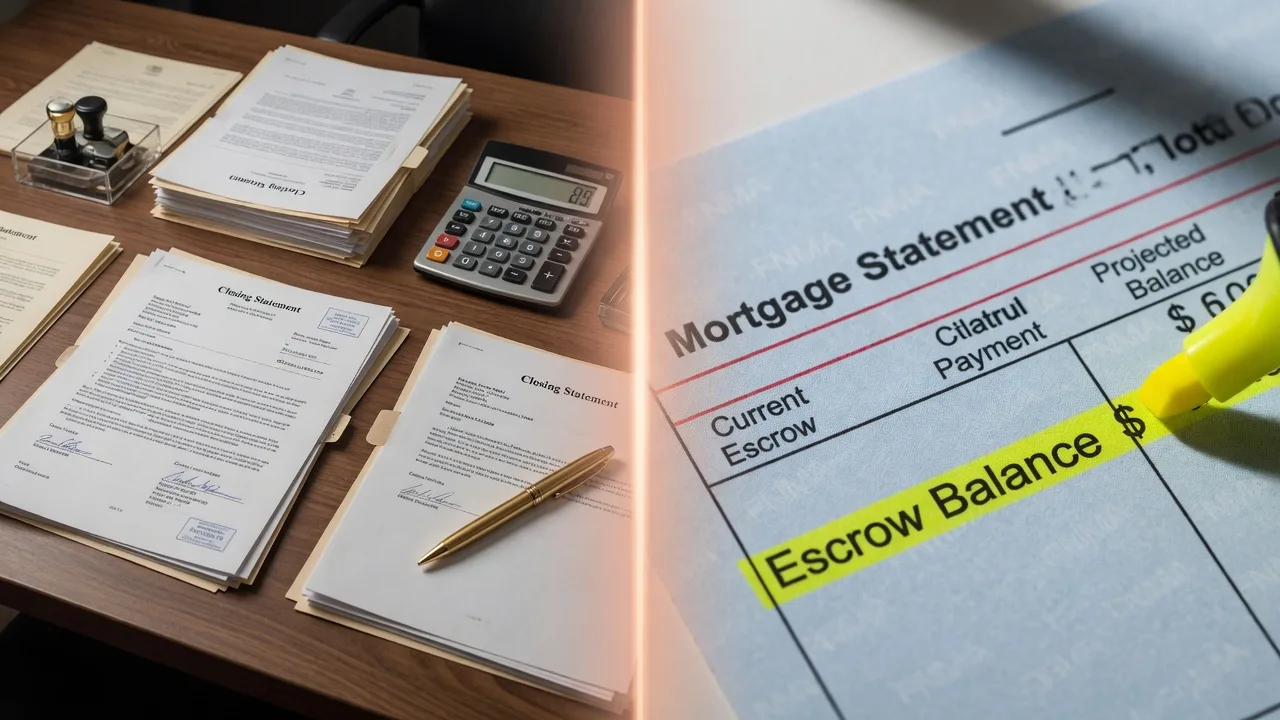
Here is a scenario that confuses a surprising number of homebuyers.
During the closing process, your title or escrow company tells you your earnest money and closing funds are being held "in escrow." You sign the papers, get the keys, and move in.
Six months later, you get your mortgage statement and it shows an "escrow balance." Maybe it went up. Maybe it went down. You are not entirely sure what it is.
Same word. Two completely different things. Here is how to tell them apart.
Escrow Type 1: The Transaction Escrow (Title Company)
The first kind of escrow is the one that happens during a real estate purchase or refinance. This is the escrow managed by a title company, escrow company, or settlement agent.
In this context, escrow is a neutral holding tank. The buyer deposits earnest money and closing funds into an escrow account. The seller deposits the signed deed. The lender deposits the loan proceeds. Nobody gets anything until all the conditions of the transaction are met.
The escrow officer's job is to follow the written escrow instructions and make sure every condition is satisfied before funds or documents are released. This includes verifying that the title is clear, that the lender's conditions are met, and that all parties have signed what they need to sign.
Once everything checks out, the escrow officer disburses the funds: paying off the seller's mortgage, recording the deed, paying taxes and recording fees, sending commissions, and distributing the seller's net proceeds.
At that point, the transaction escrow is over. The account is closed. The title company's role in that escrow is done.
Escrow Type 2: The Mortgage Escrow Account (Lender)
The second kind of escrow is entirely different. This is the escrow account that your mortgage lender or servicer manages after closing.
When you get a mortgage, your lender may require you to pay for property taxes and homeowner's insurance through a monthly escrow payment. Each month, a portion of your mortgage payment goes into an escrow account held by the lender. When your property tax bill comes due, the lender pays it from that account. When your insurance premium is due, the lender pays that too.
This is not a neutral holding tank. It is a forced savings account designed to make sure the taxes and insurance get paid on time. The lender has a financial interest in making sure the property is insured and the taxes are current, because if either one lapses, the lender's collateral is at risk.
Key Differences at a Glance
| Feature | Transaction Escrow | Mortgage Escrow |
|---|---|---|
| Who manages it | Title or escrow company | Your mortgage lender or servicer |
| When it happens | During the purchase or refinance | After closing, for the life of the loan |
| What it holds | Earnest money, closing funds, documents | Tax and insurance payments |
| Who it protects | Both buyer and seller | The lender (and indirectly the borrower) |
| Duration | Short-term (weeks or months) | Long-term (years, until loan is paid) |
Why the Confusion Matters
Most of the time, confusing the two kinds of escrow does not cause real problems. But there are situations where the distinction matters.
If you hear "your escrow is short" from your mortgage servicer, they are talking about your tax and insurance escrow account. It means there is not enough money in that account to cover the upcoming bills. Your monthly payment may go up.
If you hear "your escrow has been disbursed" from your title company, they mean the transaction escrow has been closed and the funds have been paid out. The closing is complete.
Understanding which escrow someone is talking about can save you from worrying about the wrong thing.
Can You Opt Out of the Mortgage Escrow?
Some lenders require escrow accounts for certain types of loans. FHA and USDA loans, for example, require escrow accounts for the life of the loan. Conventional loans may require escrow if your down payment is below 20%.
If you put down 20% or more on a conventional loan, many lenders will let you waive the escrow account and pay taxes and insurance directly. Some lenders charge a small fee for this privilege.
The transaction escrow, by contrast, is not optional during a purchase. It is the mechanism that makes the closing work. You cannot waive it because it is not an add-on service. It is the process itself.
The Bottom Line
Escrow is not one thing. It is two things that share a name.
The transaction escrow is the short-term, neutral account managed by the title or escrow company during the closing. The mortgage escrow is the long-term, tax-and-insurance account managed by your lender for the life of the loan.
Knowing the difference will not just help you sound informed at dinner parties. It will help you ask the right questions when someone in real estate says "your escrow."
This article provides general educational information and is not legal or financial advice. Escrow practices and requirements vary by lender, loan type, and state law. Ask your lender and title company for details specific to your transaction.