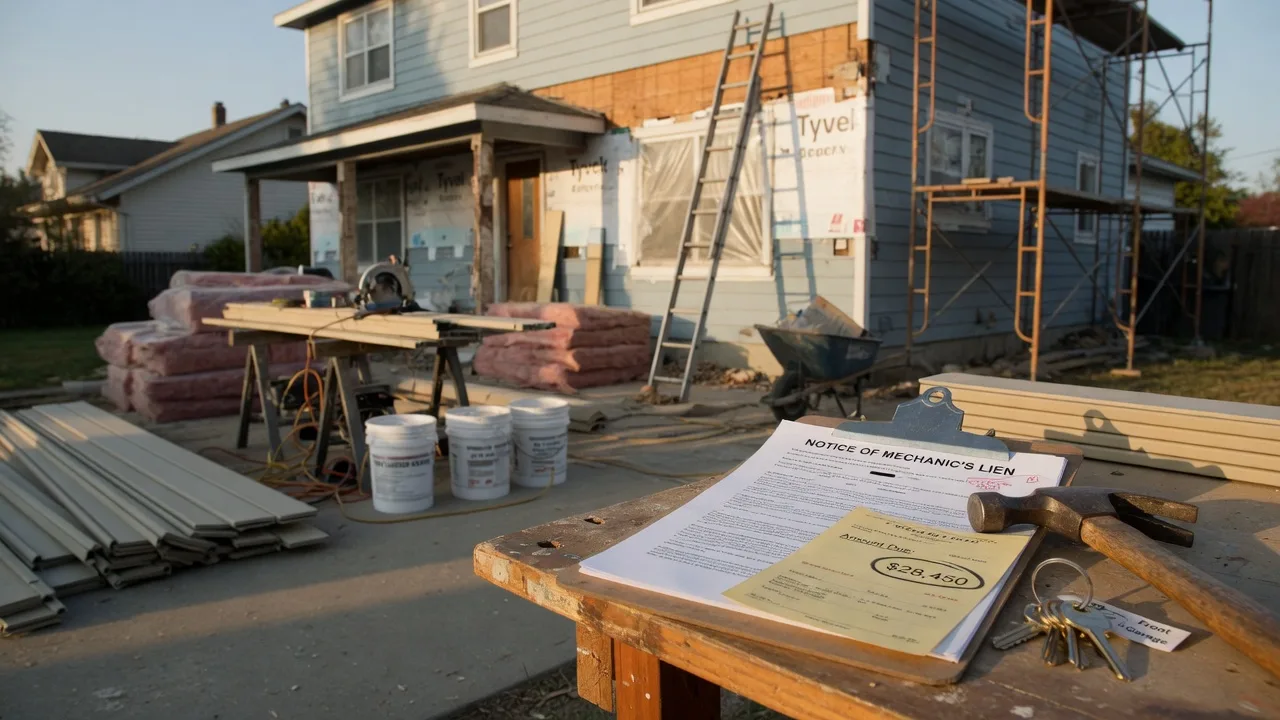
A court judgment can follow you for years without you thinking about it, and then one day it shows up on a title commitment as a lien against your house and stops a sale or refinance cold. In Nevada, a docketed district court judgment automatically becomes a lien on all of the debtor's real property in the county where it is recorded, under NRS 17.150, and it lasts six years and keeps renewing every time the creditor renews the judgment. This article explains how judgment liens actually work in Nevada, the six-year clock and how renewal keeps it alive, what the state's two leading Supreme Court decisions on the subject decided, how child support liens differ, and exactly what happens at the closing table when one shows up.
Every statute and case below is identified by name and citation in the Data & Sources section. This article is general educational information about how title companies handle judgment liens, not legal advice, and anyone facing a judgment lien on their home should talk to a Nevada attorney about their specific facts.
The Scenario That Starts the Problem
A seller lists their house, gets an offer, and the title company orders the search. The commitment comes back with an exception for a judgment lien. The seller is baffled: they have no memory of a judgment, or they remember a lawsuit from six years ago that they assumed was water under the bridge. What the seller is really asking is whether a creditor who won a lawsuit against them years ago can still reach the house today. In Nevada the answer depends on a clock, a piece of paper, and whether anyone renewed the judgment in time.
The lien does not have to be dramatic to be real. A credit card debt that went to a collection lawsuit, an unpaid medical bill reduced to judgment, a business dispute, a car loan deficiency, a landlord's damages award: any money judgment from a Nevada district court can become a lien on real property the moment it is properly recorded in the county where the debtor owns property.
What a Judgment Lien Actually Is
Under NRS 17.150, when a district court judgment is docketed and recorded in a Nevada county, it becomes a lien on all of the judgment debtor's real property in that county. Two details matter here. First, the lien attaches to property the debtor already owns and to property the debtor acquires later, so a judgment recorded years ago can attach to a house bought long after the lawsuit ended. Second, the lien is against real property only under this statute, which is one reason title companies search judgment indexes county by county: a judgment recorded in Clark County does not automatically appear in a search of Washoe County, and a Nevada judgment does not automatically show up in California.
A judgment lien is involuntary, which is the polite way of saying the owner never agreed to it. It is not like a mortgage or a deed of trust, which the owner signs. The creditor recorded a court document, and the law did the rest. That is why it can come as a total surprise at closing, and why it is one of the most common last-minute closing problems in the state.
The Six-Year Clock, and How Renewal Keeps a Lien Alive
The judgment lien lasts six years from the date the judgment is docketed, under NRS 17.150(2), and it is continued each time the judgment itself is renewed. A judgment in Nevada is renewed under NRS 17.214, by filing an affidavit of renewal before the existing judgment expires, and successive renewal affidavits may be filed within 90 days before a prior renewal expires. The practical effect is that a judgment can be kept alive in six-year increments almost indefinitely, as long as someone files the renewal on time.
This is the detail that catches people. A judgment from 2012 can still be blocking a sale in 2026 if it was renewed in 2018 and again in 2024. The age of the lawsuit is not the question. The question is whether the most recent renewal was filed before the prior period expired. A title company reading a commitment does not look at how old the judgment looks; it looks at the recorded renewal affidavit, and the filing dates.
When the Six Years Run Out: Evans v. Samuels
The Nevada Supreme Court drew the clearest line in Evans v. Samuels, 119 Nev. 378 (2003). There, a creditor held a judgment lien against real property, the six-year period from docketing passed, and the creditor attempted to renew after the lien had already expired. The court held that a judgment lien under NRS 17.150 expires after six years from docketing if it is not renewed, and that renewing after expiration does not revive the lien. In that case, the buyer took the property free of the expired judgment lien. The practical takeaway for title work: when a search finds a judgment lien with no timely renewal on record, the title company treats it as dead and generally does not require it to be paid out of the seller's proceeds.
Four years later, in Leven v. Frey, 123 Nev. 399 (2007), the court made clear that the renewal itself has to be done correctly: a renewal affidavit must be timely filed, recorded, and served, or the lien does not continue. A renewal that is filed late, recorded in the wrong office, or never served on the debtor can fail, which means the lien lapses even though the creditor intended to renew it. Title examiners check renewal paperwork with the same care they check the original judgment, because a defective renewal is exactly the kind of thing that looks valid in the file and fails under scrutiny.
The 2011 Recording Requirement
A 2011 amendment to NRS 17.150 added another layer of protection for buyers and lenders. Under NRS 17.150(4), a creditor must record an affidavit of judgment identifying the debtor and the case number for the lien to give notice to later purchasers. Before that change, a judgment could arguably bind later buyers even when the court records did not connect the judgment to a specific debtor in a searchable way. Today, the recorded affidavit is what makes the lien searchable and what gives the title company something to clear. A judgment that predates the amendment may still be enforceable against the debtor, but the recording mechanics matter at closing, and this is one more reason title companies pull the actual recorded documents rather than relying on a summary.
Child Support Liens Are Different
The six-year judgment lien clock does not tell the whole story, because child support judgments operate under their own statute. Under NRS 125B.142, when a support order is recorded after an arrearage, it becomes a lien on both the real and personal property of the responsible parent, which is broader than the real-property-only lien of NRS 17.150. Nevada law also provides that the standard property exemptions, including the homestead exemption, may not apply to proceedings enforcing a child support judgment. For a title company, the lesson is to distinguish the two: a child support judgment is checked and cleared differently from an ordinary money judgment, and it can reach property that a regular judgment lien cannot.
The Homestead Complication
Nevada's homestead law adds a genuine wrinkle. NRS 17.150(2) makes a judgment a lien on the debtor's real property, but only on property not otherwise exempt from execution, and NRS 115.010 exempts a designated homestead from forced sale up to a statutory equity cap. The Nevada Supreme Court has held that an abstract judgment lien under NRS 17.150 cannot attach to property that is fully exempt from execution under NRS 115.010. The exemption cap has been amended over time, and the analysis depends on the equity in the home at the relevant moment, so this is the point where title companies often consult the underwriter and where a seller with a homesteaded property and a judgment lien genuinely needs a Nevada attorney's opinion. What matters for this article is that the homestead exemption can change the outcome, and a judgment lien on a house with little equity is a different problem from a judgment lien on a house with substantial equity.
What Happens at the Closing Table
When a title search finds a valid, unexpired judgment lien, the closing does not necessarily fall apart, but it does not close on the original terms either. The standard sequence looks like this. The title company requires a written payoff or demand statement from the judgment creditor showing the exact amount needed to satisfy the judgment, including interest and any costs the judgment allows. At closing, that amount is paid from the seller's proceeds, and the creditor is required to execute a release or satisfaction that gets recorded to clear the lien from the title. The seller's net check is smaller than the contract said it would be, which is why sellers who have any doubt about their judgment history should find out before they list.
If the lien has expired because the six-year period ran without a timely renewal, the title company treats it as dead under Evans and generally does not require a payoff, and the buyer can take title free of it. If the judgment is against one spouse and the property is held in a way that the judgment does not attach, or if the property is fully exempt homestead property, the title company may remove the exception with supporting documentation instead of requiring a payoff. Every one of these paths depends on the actual recorded documents, which is why the commitment, not the seller's memory, is the record of truth.
What to Do If You Might Have a Judgment Lien
- Before you list or refinance, ask your title company to run a judgment search in every county where you have owned real property. A judgment lien follows the debtor's property in each county, and it costs far less to find it now than to renegotiate a contract after it surfaces.
- Check the renewal dates. A judgment from a lawsuit you lost ten years ago may still be alive if it was renewed. The recorded renewal affidavit, not the lawsuit date, is what determines whether the lien is still enforceable.
- If a judgment is against you and you plan to sell, get the payoff amount in writing from the judgment creditor early. Payoffs can include accrued interest and costs, and the number on the court docket is rarely the number at closing.
- If you believe the judgment has expired or was defectively renewed, do not assume it will fall off. A Nevada attorney can review the recording and renewal chain, and the title company's underwriter will want to see the analysis before insuring over it.
- Do not rely on the homestead exemption to make a judgment lien disappear. The exemption protects against forced sale up to a cap under NRS 115.010, but a voluntary sale to a buyer is a different transaction, and child support liens are treated separately under NRS 125B.142.
What to Do If You're Buying a House With a Judgment Lien Exception
- Let your closing team do its job. A judgment lien exception on the commitment is a routine finding, and the seller or the title company will typically clear it with a payoff and recorded release before you sign.
- Do not accept a seller's verbal promise to pay it later. The lien has to be released on the public record, or you could inherit the problem, because the lien attaches to the property, not to the seller's word.
- If the seller cannot pay the judgment out of proceeds and the lien will not be released, the transaction may need a negotiated solution, such as a price adjustment or a title insurance approach approved by the underwriter. That is a legal and financial decision to make with professional advice, not at the kitchen table.
The Bottom Line
A judgment lien in Nevada is a quiet, powerful encumbrance: a docketed district court judgment becomes a lien on all of the debtor's real property in the county under NRS 17.150, lasts six years, and keeps renewing every time the judgment is renewed under NRS 17.214. It attaches to houses bought long after the lawsuit, it catches sellers by surprise at the closing table, and it gets paid out of the seller's proceeds with a recorded release before title can be insured. The Nevada Supreme Court's decisions in Evans v. Samuels and Leven v. Frey give the system its two guardrails: a lien that expires after six years without a timely renewal is dead and does not revive, and a renewal that is not filed, recorded, and served correctly does not continue the lien. Child support liens reach more property under NRS 125B.142, and the homestead exemption can change the analysis entirely, which is why judgment lien questions are a case-by-case matter for the underwriter and for a Nevada attorney. For sellers, the practical lesson is to run the judgment search before you list, and for buyers, to let the closing team clear the exception properly, because the one thing you never want is to buy a house and inherit a judgment you never owed.
Data & Sources
Statutes, Cases, and Procedures
- NRS 17.150 (Nevada Revised Statutes, Chapter 17): docketing and recording a district court judgment creates a lien on all real property of the judgment debtor in the county, including property acquired after the judgment; under NRS 17.150(2) the lien lasts six years from the date the judgment is docketed and is continued each time the judgment is renewed; under NRS 17.150(4), added by a 2011 amendment, a creditor must record an affidavit of judgment identifying the debtor and case for the lien to give notice to later purchasers. (leg.state.nv.us, NRS Chapter 17; Justia, Nevada statutes 2023, NRS 17.150.)
- NRS 17.214 (Nevada Revised Statutes, Chapter 17): renewal of a judgment by filing an affidavit of renewal before the existing judgment expires; successive affidavits may be filed within 90 days before a prior renewal expires. (leg.state.nv.us, NRS Chapter 17; UNLV Nevada Supreme Court summaries.)
- Evans v. Samuels, 119 Nev. 378, 75 P.3d 361 (2003): a judgment lien under NRS 17.150 expires after six years from docketing if not renewed, and renewing after expiration does not revive the lien; the buyer in that case took the property free of the expired lien. (courtlistener.com; UNLV scholars.law.unlv.edu Nevada Supreme Court summaries.)
- Leven v. Frey, 123 Nev. 399 (2007): a renewal affidavit must be timely filed, recorded, and served, or the lien does not continue. (static.case.law Nevada Reports, 123 Nev. 399.)
- NRS 115.010 (Nevada Revised Statutes, Chapter 115): the homestead exemption protects a designated homestead from forced sale up to a statutory equity cap; the cap has been amended over time and the current figure should be confirmed in the statute. The Nevada Supreme Court has held that abstract judgment liens under NRS 17.150 do not attach to property that is fully exempt from execution under NRS 115.010 (see Nevada Reports, 123 Nev. p. 20 line of cases). (leg.state.nv.us, NRS Chapter 115; static.case.law, Nevada Reports 123 Nev. 20.)
- NRS 125B.142 (Nevada Revised Statutes, Chapter 125B): a recorded support order following an arrearage becomes a lien on both real and personal property of the responsible parent, broader than the real-property-only lien of NRS 17.150; the standard property exemptions, including the homestead exemption, may not apply to proceedings enforcing a child support judgment. (leg.state.nv.us, NRS Chapter 125B; Nevada Senate Journal, 73rd Session, sj075.pdf.)
- Closing procedure: title searches and commitments reveal judgment liens; escrow and title companies require a written payoff or demand statement from the judgment creditor and pay the judgment from the seller's proceeds at closing, with a recorded release or satisfaction of judgment to clear title; an expired, unrenewed judgment lien is treated as dead and generally does not require payoff. (Standard title and escrow practice; West Coast Escrow, Payments to Debts in Advance.)
This article is general educational information about how title companies handle judgment liens and is not legal advice. Nevada statutes, court rules, and case law change, and the application of any statute or case depends on the specific facts of your situation. Consult a licensed Nevada attorney for advice about your property, your judgment, or your transaction.
This article was published November 20, 2026. It reflects Nevada law as cited in the sources above and standard title and escrow practice as commonly applied in Nevada closings. Statutory provisions, exemption amounts, and procedures can be amended, and title company requirements vary by underwriter and transaction type.