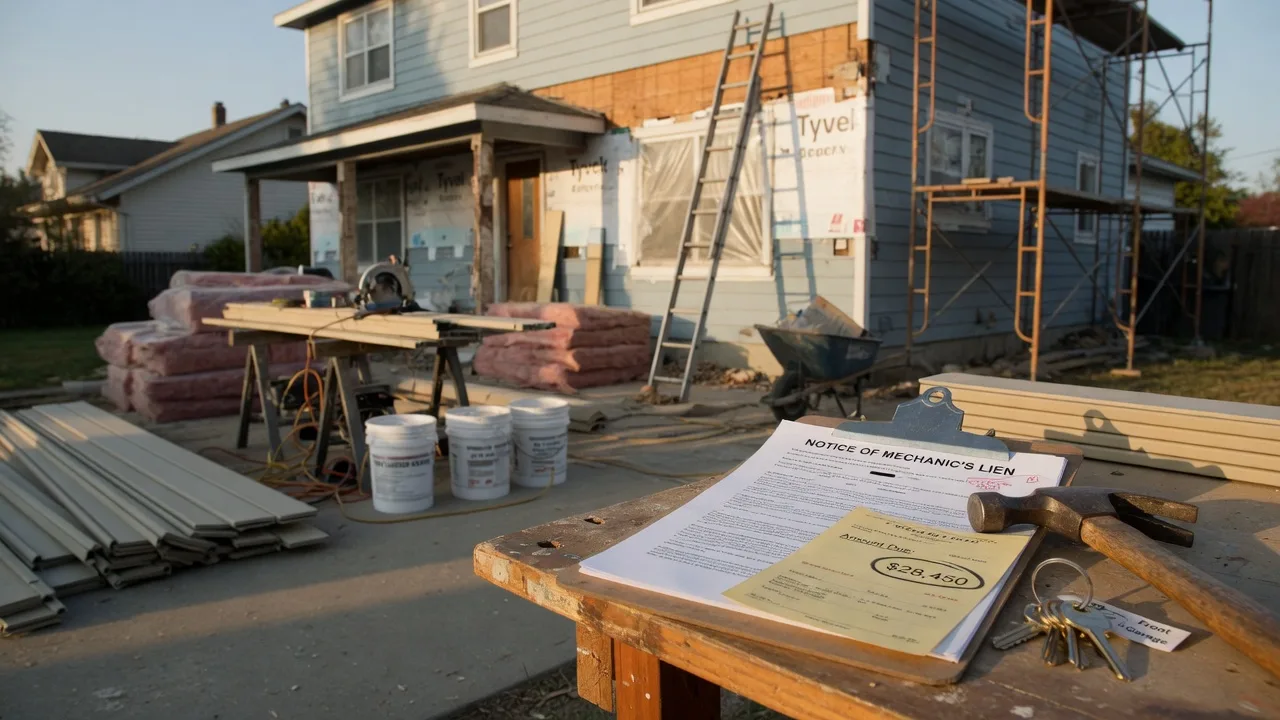
You hired a contractor, paid them in full, and the work is done. Then one day the title report on your home shows a recorded notice you have never seen: a mechanic's lien filed by a subcontractor who says they were never paid for the work on your house. You are about to sell or refinance, and suddenly a clean closing is blocked by a debt you thought you had already settled. This is the mechanic's lien double-payment trap, and it is one of the most common reasons a title search surfaces an unexpected cloud on title. This article explains how a mechanic's lien works, why it can attach to a property even after the owner paid the general contractor, what it does to a closing, and the deadlines and rules, including Nevada's, that decide whether the lien survives.
A mechanic's lien is a security interest in real property created by state law to secure payment for labor, materials, or services used to improve, repair, or maintain that property. It exists in every state, with rules that vary, and it arises by operation of law rather than by contract. Its purpose is public policy: the people who supply the work and materials that increase a property's value deserve a legal claim against that property when they are not paid.
Who Can File a Mechanic's Lien?
Anyone who directly contributes to improving the property can hold a lien right, including general contractors, who have a direct contract with the owner, as well as subcontractors, laborers, material suppliers, and in many states design professionals. In most states a claimant must be licensed for the work they performed. The key requirement is that the labor or materials were furnished to improve the property, usually with the owner's consent or at the request of the owner, a contractor, or a subcontractor.
That is where the trap begins. The owner's contract is almost always with a general contractor, but the people doing the work and supplying the materials may be many layers deep: the framer, the drywaller, the electrician, the window supplier, the concrete company. None of them have a contract with the owner, and none of them were paid directly by the owner. Their legal protection is the lien.
The Double-Payment Trap
Here is the scenario that catches homeowners by surprise. An owner pays a general contractor the full contract price. The contractor does not pay a subcontractor who worked on the project, or pockets the money set aside for materials. The unpaid subcontractor's recourse is a mechanic's lien against the property, even though the property owner already paid for the work once.
The lien attaches to the real property itself, not to the person who owes the debt. When it is recorded with the county recorder, it becomes a matter of public record, it travels with the land, and it creates a cloud on title. A buyer, a lender, and a title company all see it. Until it is resolved, the owner generally cannot sell or refinance cleanly, and depending on the state and the facts, the owner may have to pay the subcontractor a second time to clear the property, then chase the general contractor separately for reimbursement. That is why experienced title professionals and agents watch mechanic's lien exposure on every transaction where work was recently done.
What a Mechanic's Lien Does to a Closing
A recorded mechanic's lien shows up in the title search and appears as an exception on the title commitment. The title company will not issue clean title, and the lender will not fund, while an outstanding lien remains. Because the lien clouds the title, it must be cleared before a buyer and lender will close. The usual paths are the same ones used for other liens on title.
- Pay the lien claimant and record a lien release, usually from the seller's proceeds at closing, which is the most straightforward path.
- Bond over the lien, where the owner records a surety bond that substitutes for the property as security, releasing the property from the lien (in Nevada, a bond equal to 150% of the lien amount can release the property under NRS 108.2415).
- Hold back escrow funds to cover the disputed claim while the parties sort out who is owed what.
- In limited cases, have the seller sign an indemnity agreement, where the title company approves the risk.
Note that if construction work commenced before a closing, title companies routinely add a standard mechanic's lien exception and require that construction be paid off before insuring the lender's priority. Lenders especially care about priority: a mechanic's lien that relates back can threaten the first position a lender thinks it is buying.
Nevada's Rules: Deadlines and Notices
Mechanic's lien law is state law, and the details matter enormously because a single missed deadline can make a lien unenforceable. Nevada's rules live in NRS Chapter 108, and several points are worth knowing even if you never expect to deal with one. (These are general explanations of the statute; your situation needs a qualified professional.)
- Recording deadline: a lien must be recorded with the county recorder within 90 days after completion of the work of improvement, the claimant's last delivery of materials or equipment, or the claimant's last performance of work, whichever is latest (NRS 108.226). If a valid Notice of Completion is recorded, the deadline shortens to 40 days.
- Residential notice of intent: on owner-occupied residential projects, the owner must be served a Notice of Intent to Lien at least 15 days before the lien is recorded, and serving it extends the recording deadline by 15 days (NRS 108.226).
- Notice of right to lien: subcontractors and suppliers who do not have a direct contract with the owner must serve the owner a Notice of Right to Lien, and to preserve a full lien it should be served within 31 days after first furnishing labor or materials (NRS 108.245). A late notice only secures a lien for the 31 days before service plus future work.
- Enforcement deadline: a foreclosure lawsuit must be filed more than 30 days after the lien is recorded but no later than 6 months after recording, extendable in writing to up to one year. If no suit is filed in time, the lien becomes void and unenforceable (NRS 108.227).
- Service on the owner: a copy of the recorded lien must be served on the owner within 30 days of recording in Nevada.
- Releasing the property: an owner can record a surety bond of 150% of the lien amount to release the property from the lien (NRS 108.2415).
Two practical takeaways follow from the deadlines. First, a lien is not permanent by default, an unenforced lien in Nevada expires after six months. But a lien that has not yet been enforced is still a cloud on title today, and it will stop a closing today. Second, the deadlines are why the answer to any lien question is always "read the statute and talk to a title professional," because a lien recorded too late, served wrong, or never enforced may be a lien in name only.
What Owners Can Do to Protect Themselves
Prevention beats cleanup, and the tools are well established. Get lien waivers at each payment, not just at the end, and understand the difference between conditional waivers, which take effect when the payment actually clears, and unconditional waivers, which take effect immediately. When you pay a general contractor, ask for lien releases from the subcontractors and suppliers you know worked on the project. Never make the final payment without final releases in hand. Keep a paper trail of every contract, change order, and payment.
If you are selling after recent work, run a title check before you list. A title search will surface any recorded lien while there is still time to resolve it, and a resolution before listing is far cheaper and easier than one discovered three days before closing. A Property DNA Report or a preliminary title report ordered early gives you the same early warning.
What Buyers and Agents Should Know
For buyers, the lesson is to expect a mechanic's lien review whenever a home has had recent construction, and to understand that a title commitment that shows construction work will likely carry a mechanic's lien exception until the work is paid for and the exception is removed. For real estate agents, a mechanic's lien is a classic last-minute closing killer, the kind that shows up in a title search and forces a scramble through payoffs, releases, and bonding. Asking the seller early whether any work was done in the past year or two, and whether all contractors and subs have been paid and released, can turn a closing emergency into a non-event.
For title professionals and escrow officers, the mechanic's lien question is about priority and timing: was the work started before or after the mortgage, was a notice properly served, and is the lien still enforceable? Getting those answers right protects the lender's position and gets the seller to a clean closing.
The Bottom Line
A mechanic's lien is a statutory claim against real property for unpaid labor, materials, or services, and it can attach to a home even when the owner already paid the general contractor in full. It becomes a cloud on title that blocks a sale or refinance until it is paid, bonded over, held back, or otherwise cleared. The rules are state-specific and deadline-driven, in Nevada they live in NRS Chapter 108, with a 90-day recording window, residential notice requirements, and a six-month enforcement period. The good news is that the problem is almost always fixable, and it is far easier to fix before you list than after a closing date is set. If a mechanic's lien ever appears on your title report, treat it as a solvable problem, not a disaster, and let your title company walk you through the options.
Sources
Reference Material
- How mechanic's liens work generally: who can file, what triggers the right, how the lien attaches to real property, and how it affects a sale or refinance: Cornell Law School Legal Information Institute, Nolo, and Investopedia.
- Nevada mechanic's lien law: recording deadline of 90 days after completion or last work or materials, shortened to 40 days after a Notice of Completion (NRS 108.226); residential Notice of Intent to Lien at least 15 days before recording (NRS 108.226); Notice of Right to Lien within 31 days of first furnishing for claimants without a direct contract with the owner (NRS 108.245); enforcement lawsuit between 30 days and 6 months after recording, extendable to one year, with the lien void if not enforced in time (NRS 108.227); surety bond of 150% of the lien amount to release the property (NRS 108.2415); service of the lien on the owner within 30 days of recording (NRS 108.233): Nevada Revised Statutes Chapter 108 (Nevada Legislature), the Nevada State Contractors Board, and the Levelset Nevada lien law guide.
- How title companies handle an active mechanic's lien at closing, including pay-off and release, bonding, escrow holdbacks, indemnity agreements, and the standard construction-in-progress exception on a title commitment: title industry practice guides (First Integrity Title, Viva Escrow, US Title Records) and construction lien law references.
This article is provided for general educational purposes and is not legal advice. Mechanic's lien law varies by state and is deadline-driven, and the resolution of any lien depends on the specific facts and the law of the jurisdiction where the property is located. Consult a qualified title professional or attorney for guidance on your situation.