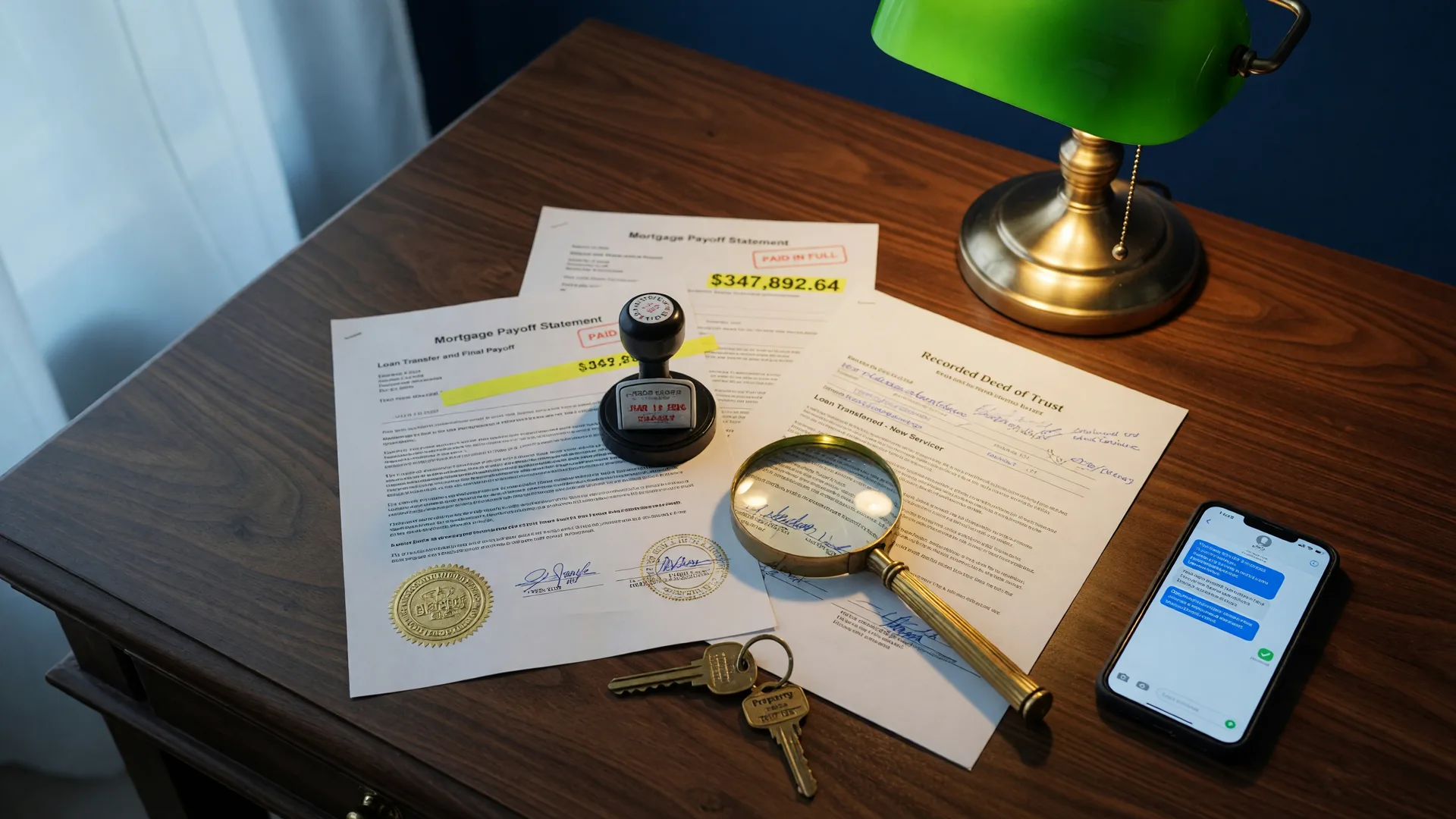
At almost every closing, someone notices the same thing and asks the same question. The seller's payoff statement comes from a company they have never heard of, a name that is not on any of their mortgage papers, while the deed of trust recorded in the county records names a lender that may not even exist anymore. None of it is a mistake. Your mortgage was sold, probably more than once, and almost none of those sales were recorded in the public record. That gap between what the county says and who actually holds the loan is one of the most misunderstood parts of any transaction, and it is exactly where delayed closings, unrecorded releases, and payoff mistakes are born. Here is how loans change hands behind the scenes, why the title company still manages to find the right party, and what Nevada's law requires before that old lien finally comes off the record.
Every Mortgage Is Two Documents, and They Lead Separate Lives
The confusion starts here. A home loan is not one document; it is two, and they do very different jobs.
- The promissory note is your promise to repay. It is a negotiable instrument, meaning it can be sold, endorsed, and transferred from one party to another, largely in private, without ever touching a county recorder's office. Whoever holds the note has the right to be paid.
- The deed of trust (or mortgage) is the recorded security instrument. It pledges the property as collateral and is the document that appears in the county's chain of title, naming the lender (or trustee and beneficiary) and giving them the power to foreclose if the loan defaults. This is the document title examiners search, and it is public.
When a mortgage is sold, both can change hands, but the two transfers move on completely different tracks. The note can be transferred with a simple endorsement, quickly and invisibly. The deed of trust is supposed to be transferred by a recorded assignment, but in practice the assignment is often never recorded at all. So the county record can sit there for years showing the original lender, even after the loan has been sold twice, securitized, and had its servicing moved to a third company.
Loans Get Sold All the Time. The Public Record Rarely Catches Up.
If you bought a home before the mid-1990s and never refinanced, your loan may genuinely still be with the lender you signed with. For almost everyone else, assume it has been sold. Most conforming loans ended up owned by Fannie Mae or Freddie Mac or inside a mortgage-backed securitization trust, and the ownership can change again if the loan is transferred between portfolios. The borrower usually finds out only by a "your loan has been transferred" letter, and frequently not even by that, because servicing can move while the ownership stays the same, or ownership can change while the servicer you pay stays the same.
The reason the recorded deed of trust keeps naming a company that no longer owns the loan is MERS, the Mortgage Electronic Registration System. The vast majority of deeds of trust recorded in the United States name MERS as the beneficiary, acting as "nominee" for the lender and its successors and assigns. When members sell or transfer loans, they update the transfer on MERS's private electronic registry instead of recording an assignment in every county. That is legal, efficient, and standard, and it is why the public record very often carries no trace of who actually owns the debt.
The Three Faces of "Your Lender"
By the time you go to closing, your loan may have three different companies involved, and they are not the same entity:
- The note holder (investor): the entity that actually owns the debt and has the right to payment. Often Fannie Mae, Freddie Mac, or a securitization trust. It may never appear anywhere in your public record.
- The servicer: the company that manages the loan day to day, collects your payments, runs your escrow account, and, critically for this discussion, issues payoff statements. Servicing rights can be bought and sold separately from loan ownership, which is why the company on your monthly statement can change even when nothing else does.
- The beneficiary of record: the name on the recorded deed of trust, usually MERS or the original lender. This is the version of "your lender" that exists in the county's records, and it is frequently the least accurate about who actually owns the loan today.
The Consumer Financial Protection Bureau's guidance for consumers is simple and correct: your servicer is required to tell you who owns your loan, and you can find it in writing by contacting your servicer directly. But at a closing, the title and escrow team cannot wait for a letter, so it uses a faster, industry-standard shortcut.
What That Means at Your Closing
When a home with a mortgage is sold or refinanced, the closing agent must pay off the existing loan, in full, on the closing date, to the right recipient, or the old lien does not go away. Here is the process, in the order it actually happens:
- Identify the servicer. The recorded deed of trust usually will not tell you who to pay, so the closing team identifies the current servicer through MERS ServicerID, the free lookup that returns the current servicer and investor for most loans, and cross-checks it against the borrower's recent statement.
- Order the payoff in writing. Under federal Regulation Z, a servicer must provide an accurate payoff statement within seven business days of a written request. The payoff quote includes per-diem interest, so the amount grows every day the closing slips, which is why payoff statements carry a "good through" date, a subject we covered in depth in Payoff Statements Expire. Here's Why That Slipped Your Closing Date.
- Verify before you pay. The closing agent confirms the payee against the servicer ID and the investor, because paying a company that merely used to hold the loan means the money goes to the wrong place and the release never gets recorded.
- Fund and track the release. Once the loan is paid from closing funds, the lender or servicer must produce the release of the deed of trust, and somebody has to make sure it actually gets recorded. That last step is where loans go to die, and it is why a payoff that happened correctly years ago can still surface at today's closing. See You Paid Off Your Mortgage. Why Is It Still Showing Up on Your Title? for what happens when the release was never recorded.
Nevada's Deadlines for Getting the Lien Off the Record
Nevada law sets specific clocks for this process, and they are worth knowing because they tell sellers exactly how long "clearing the old lender off your title" can take. Under NRS 107.077:
- Within 21 days after receiving written notice that the debt is paid or satisfied, the beneficiary (the "lender" in the note-and-deed-of-trust sense) must deliver to the trustee or trustor the original note and deed of trust, if it has them, and a properly executed request to reconvey.
- Within 45 days after the debt is paid and a properly executed request to reconvey is delivered, the trustee must record the reconveyance of the deed of trust with the county recorder.
- If the beneficiary or trustee fails those deadlines, they are liable in a civil action to any party to the deed of trust for actual damages caused by the failure, plus reasonable attorney's fees and costs.
Two practical wrinkles in Nevada. First, for deeds of trust that were recorded by microfilm or another photographic process, a marginal release on the side of the recorded page is not permitted; the recorded release must be an acknowledged reconveyance, NRS 107.073. Second, when the beneficiary genuinely cannot be located or will not cooperate, NRS 107.079 provides a remedy, including a surety bond and declaration procedure, so a seller is not trapped by a lender that has disappeared. These statutes exist precisely because the gap this article describes, a paid and released loan whose recorded lien lingers, is common enough that the legislature wrote specific timelines and penalties around it.
Why the Title Company Asks for Your Latest Statement
If you have ever wondered why your closer asks for a copy of your most recent mortgage statement when your payoff already exists, this is why. The statement shows the current servicer and loan number, which is the fastest, most accurate verification available, and it lets the closing team confirm the servicer registry matches reality. A statement from six months ago may show a different servicer than today, because servicing transfers happen quickly and quietly. The most common "small thing" that turns into a delayed closing is a payoff ordered from the wrong servicer, found out only days before funding. Submitting your current statement when asked is one of the single highest-leverage things a seller can do to keep a closing on schedule.
What Buyers, Sellers, and Agents Should Actually Do
- Sellers: keep your statements current, and do not be surprised by the payoff recipient. If the name is unfamiliar, that is normal, and a legitimate closer verifies payees rather than trusting the envelope. Never send a payoff directly to any company at anyone's emailed instruction; payoffs move through closing.
- Buyers: a deed of trust that still names an old lender or MERS is not a title defect by itself; it is the modern norm. What matters is that the payoff is verified and the release gets recorded. Ask your closing team whether the release will be recorded promptly after closing, and give yourself the peace of mind of checking the county record a few weeks later.
- Agents: set expectations early. A payoff statement takes up to seven business days to obtain under Regulation Z, expires as interest accrues, and the release of the old lien typically records after, not at, closing. Build those steps into your closing timeline, and tell your seller to send the current statement the moment the file opens.
- Investors and attorneys: when a transaction involves a paid-off loan with no recorded release, or a loan whose ownership chain is unclear, title work resolves it, and Nevada's NRS 107.077 and 107.079 timelines tell you how long the cleanup can take and who bears the cost.
The Bottom Line
The lender on your deed of trust is frequently a historical artifact, and the company that actually owns your loan may never appear in the public record at all. That is not dysfunction; it is how the modern mortgage market works, with notes transferable in private and deeds of trust living on a registry. The system holds together only because closing teams identify the true servicer, order verified payoffs, and track releases to recording, and because state law like Nevada's NRS 107.077 gives clear deadlines and damages when the release does not happen. The next time a payoff statement arrives from an unfamiliar company, or the county record shows a lender that has not been in business for years, you will know what is happening, and you will know exactly what has to happen before that old lien leaves your title for good.
Have questions about a payoff, a release that never recorded, or what a deed of trust showing an old lender means for your transaction? Talk to our team, or start a title order and we will pull the records and walk you through what we find.
Sources & Important Information
This article draws on the MERS System FAQ, the MERS ServicerID service, the CFPB's consumer guidance on how to find out who owns your mortgage, Regulation Z (12 CFR 1026.36(c)(3)) on payoff statement timing, and Nevada law including NRS Chapter 107 (in particular NRS 107.073, 107.077, and 107.079) and NRS Chapter 106 (NRS 106.210) for real mortgages.
This article describes how mortgage ownership, servicing, payoff, and release work in the typical U.S. transaction and under Nevada law specifically; state rules vary, and loan documents and servicing agreements can differ from loan to loan. It is general educational information, not legal advice, and does not replace the payoff and release requirements of any specific lender, servicer, or jurisdiction. Talk to your closing team or attorney about the requirements for your transaction.