A mortgage rate lock is a lender's commitment to hold a quoted interest rate for a set period, and when that period runs out before closing, the lender reprices the loan at whatever the market is doing that day. In a market like this one, where the 30-year fixed has moved from 7.28% to 7.21% to 7.38% inside two weeks, an expired lock can cost a buyer thousands of dollars in extension fees, or leave them permanently stuck with a higher rate and a larger monthly payment. This article explains exactly what happens at the moment a lock expires, what extension fees really cost, the rule about the three-day Closing Disclosure clock that most buyers get wrong, and how to keep it from happening on your transaction.
This article is general educational information about how mortgage rate locks and closing timelines work, not legal or lending advice. Lock and extension policies are set by each lender, and anyone with a specific lock, extension, or closing question should get the terms in writing from their own lender.
What a Rate Lock Actually Is
A rate lock is not a loan approval and it is not a guarantee of a closing date. It is a pricing commitment: the lender promises that the interest rate, and any points attached to it, will not change between the day you lock and the expiration date, regardless of what the bond market does in between. The Consumer Financial Protection Bureau describes 30, 45, and 60 days as the common lock periods, with some lenders offering everything from a short 7-day post-approval lock up to 120 days, and longer locks cost more because the lender carries more market risk. A 45- or 60-day lock typically runs about 0.125% to 0.25% higher in rate, or costs additional upfront points, compared with a 30-day lock. Some lenders offer extended multi-month locks for new construction, where the closing date is inherently uncertain.
The reason the lock exists is that rates move constantly. As this article went out, Freddie Mac's most recent survey put the 30-year fixed at 7.21%, the Mortgage Bankers Association's contract-rate measure was at 7.38%, and the market had swung 15 to 30 basis points in a single week more than once this autumn. If you are quoted a rate on Monday and do not lock it, that rate is a suggestion, not a promise. Locking is how you turn the suggestion into a binding price.
Why Locks Expire More Often in a Market Like This One
Locks expire because closings run long, and closings run long because the process has more steps than most buyers realize. Industry data from ICE Mortgage Technology shows the average conventional purchase loan takes about 43 days from application to clear-to-close, and roughly one in three transactions still hits a significant delay somewhere in that window. The common culprits are the same list every closer knows by heart: appraisal comes in late or low, underwriting asks for another round of documents, a title problem shows up in the commitment, HOA documents are slow to arrive, a home-sale contingency on the buyer's side has not closed, inspection negotiations drag, or a wire transfer goes sideways at the last minute. In a slow market like this one, add the calendar: fewer appraisers and lenders are in a hurry, sellers push back on terms, and holiday weeks like Thanksgiving and the year-end compress working days, which is how a 45-day lock scheduled to expire on December 15 quietly becomes a problem.
The specific failure mode matters. A buyer locks early, the closing date slips two weeks for reasons that feel outside their control, and the lock, which had been a footnote in the paperwork, suddenly becomes the most expensive line item in the file.
The Exact Moment a Lock Expires
When the lock date passes without closing, the lender generally reprices the loan at the prevailing market rate as of the expiration date. Your original rate does not stay in effect automatically, and there is no grace period by default, though some lenders build one into their policy and others do not. At that point the buyer usually has three options. Accept the repriced rate, whatever it is, and close with a higher monthly payment. Pay an extension fee to keep the original rate for an additional block of days. Or let the rate float, meaning it is whatever the market offers when the loan actually funds, which is a gamble in either direction.
The lender holds the pricing power here, which is the part most buyers do not expect. You cannot appeal an expired lock to a regulator or a title company; the title company does not set, extend, or waive lock terms. The extension is a negotiation with the lender, and the lender's willingness to work with you depends on its policy, the loan program, and how close you are to actually closing.
What an Extension Actually Costs
There is no standard price for a lock extension. Each lender sets its own schedule, and the CFPB warns that extensions can be expensive, which is why it advises borrowers to pick a lock period that extends a few days past the expected closing date and to get the extension price in writing when locking. In practice, extensions are charged either as a flat fee, often a few hundred dollars, or as a percentage of the loan amount per block of extra days. One published example, from San Diego County Credit Union's rate lock policy, charges 0.125% of the loan amount for a first 15-day extension, an additional 0.25% for a second 30-day extension, and an additional 0.50% for a third 30-day extension. On a $400,000 loan, the first extension alone is $500, the second is another $1,000, and the third is another $2,000, and that is just to hold the original rate.
The alternative, accepting a higher rate, is a different kind of cost. Say a buyer locked a $400,000 loan at 7.21% and the lock expires into a market at 7.38%. The principal and interest payment rises by roughly $46 a month, which is more than $16,000 in additional payments over a 30-year term, before counting the interest on those extra dollars. That is the real reason lock discipline matters: an extension fee is a one-time hit, but a permanently higher rate compounds for three decades. (Those payment figures are a simple illustrative estimate at the rates cited, not a quote for any specific loan.)
The TRID Surprise: A Rate Change Doesn't Automatically Restart the Three-Day Clock
Here is the part that surprises people who have been through a closing: changing the interest rate does not, by itself, trigger a new three-business-day review period on the Closing Disclosure. Under the Consumer Financial Protection Bureau's TRID rule, the clock restarts only when one of three specific things happens: the annual percentage rate becomes inaccurate because it increases by more than one-eighth of a percentage point for a regular transaction (or more than one-quarter for an irregular transaction), the loan product changes, or a prepayment penalty is added. An interest rate change that stays inside those APR tolerances requires a corrected Closing Disclosure reflecting the new terms, but it does not restart the waiting period.
The practical caveats matter. A rate increase big enough to push the APR beyond tolerance does restart the clock, which can push the closing date by itself. And even when no new waiting period is required, the corrected Closing Disclosure still has to be provided, and a revised document late in the week can bump the closing from Friday to Monday simply because the lender needs time to reissue it and the closer needs time to reconcile the numbers. This is one of the quiet ways an expired lock delays a closing even when the buyer accepts the higher rate: not because of the three-day rule, but because of the paperwork chain.
Who Pays for an Expired Lock
The default answer is the buyer, because the lock is the buyer's contract with the buyer's lender. But it is not always that simple in practice. If the delay was the seller's fault, such as a title defect the seller had to cure or a repair the seller failed to complete, buyers have sometimes negotiated the seller to cover the extension fee or to contribute a credit toward closing costs large enough to offset it. If the delay was the lender's, buyers have successfully pushed back on the fee, and some lenders waive extension fees for delays they caused. If the buyer simply was not ready, the fee is theirs. The takeaway for both sides: the party that caused the delay is the natural target of the bill, and it is worth putting in the contract who covers a lock extension if the closing date moves, because the standard contract language rarely addresses it explicitly.
The title and escrow company sits in the middle of this: it does not set the fee, it does not collect it, and it cannot waive it, but the extension fee, if the buyer pays it directly to the lender, may not even appear on the settlement statement. If it does appear, it shows as a charge on the buyer's side of the Closing Disclosure, and the closer's job is to make sure every number on that document matches what the lender actually collected.
Float-Downs: The One-Way Insurance You Can Buy
A float-down is an optional add-on to a lock that lets the buyer lower the locked rate, usually once, if market rates drop before closing. It is one-way insurance: the lock protects against rates going up, and the float-down protects a portion of the benefit if rates go down. Most lenders require rates to drop by a minimum threshold, often 0.25% or more, before the option can be exercised, and the exercise is typically a one-time use with a deadline before closing. Not every lender offers float-downs at all, and the cost is usually 0.25% to 1% of the loan amount, paid upfront or at exercise, or baked into a slightly higher starting rate.
Whether it is worth it comes down to the market you are in. A float-down makes sense when rates are volatile and the direction is genuinely uncertain, when you are carrying a long lock with time for rates to move, and when weekly moves of 15 to 30 basis points are common, which is exactly the pattern of late 2026. It makes less sense in a flat market, where you are paying for a safety net you never use. The math to run before buying one: compare the fee against the monthly savings of a quarter-point drop, because a $1,000 to $2,000 float-down fee on a $400,000 loan can eat most of the benefit of a small rate move.
New Construction Is a Different Beast
Buyers of new construction face the highest lock-expiry risk of all, because the closing date depends on construction progress, and construction schedules slip. That is why lenders offer extended multi-month locks, sometimes 6 to 12 months, for new builds, and why builders routinely include rate-buydown incentives in their contracts: a builder who cannot get the buyer to closing at the locked rate has a pricing problem, so builders pay for points and temporary buydowns to keep the payment in range. Two cautions for new-construction buyers. First, read the builder's contract for what happens if the home is not finished by the lock expiration, because the responsibility for an extension can land on the buyer. Second, the builder's incentive is usually quoted against the builder's preferred lender, and switching lenders late can reset the entire rate picture, so compare the all-in cost of the builder's lender versus an outside lender including the value of the incentive, not just the headline rate.
How to Keep a Rate Lock From Expiring
- Lock for more time than you think you need. With the average conventional loan taking about 43 days to reach clear-to-close, a 30-day lock is a bet that nothing goes wrong. A 45- or 60-day lock costs a little more, and it is usually the cheapest insurance in the file. The CFPB's advice stands: pick a lock that extends a few days past your expected closing date.
- Get the extension price in writing when you lock. Ask the lender, before you commit, exactly what an extension costs, per day or per block of days, and what the grace-period policy is. Lenders publish these policies; asking is free.
- Start the title work the day the contract is signed. Title issues and payoff delays are the most preventable reasons a closing slips. Ordering the title commitment, the payoff statement, the HOA demand, and the survey immediately builds buffer into the schedule. The holidays make this worse, so start early in November, not mid-December.
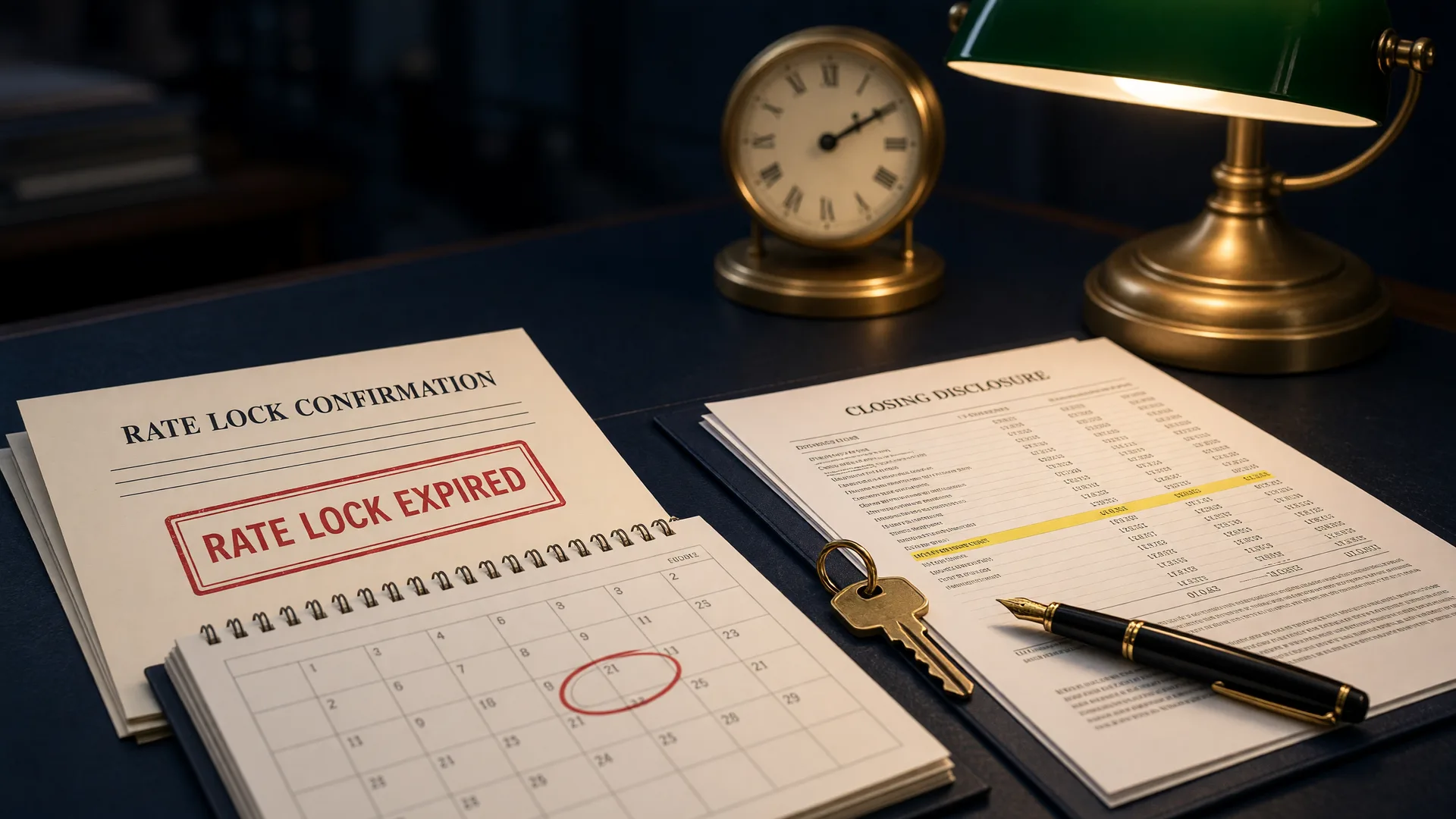
- Put your lock expiration date on the calendar, in red. Ask your loan officer for the exact date, not the week, and plan the closing at least a week before it. If the closing date moves past the lock, ask about the extension immediately; waiting until the day before gives you no leverage.
- Answer lender requests the same day. Underwriting conditions sit at the top of the delay list, and every day a document sits unanswered is a day of lock life burned. Same-day responses keep the file moving.
- Ask about a float-down before you lock, not after. It has to be part of the lock agreement. If rates are volatile and your closing is more than 45 days out, it is worth pricing.
What a Title Company Wants You to Know
From the closing side, expired rate locks are almost always a symptom, not the disease. The disease is a schedule with no buffer: a contract date, a lock date, and a closing date that all assume everything goes perfectly. The closings that meet their lock dates are the ones where the title search was ordered at contract, the payoff statement was requested before it could expire, the HOA documents were pulled early, and the buyer's lender requests were answered the same day. When a lock does expire, the best outcome is usually a combination: the buyer gets the extension fee negotiated or shared, the closing happens within the extended window, and everyone treats the near-miss as the lesson. The worst outcome, an expired lock that turns into a higher permanent rate, is preventable, and preventing it starts the week the contract is signed, not the week before closing.
The Bottom Line
A rate lock is a promise with an expiration date, and in a market where the 30-year fixed has swung between 7.21% and 7.38% in a matter of days, the difference between closing on time and closing late can cost thousands. When a lock expires, the lender reprices at the market rate, and the buyer either accepts a higher permanent rate, pays an extension fee that can run from a few hundred dollars to a percentage of the loan amount, or lets the rate float. Most buyers do not know that a rate change alone does not restart the TRID three-day clock, that extension policies vary wildly between lenders, or that the schedule buffer built in the first week of the contract is what actually protects the lock. Lock longer than you think you need, get the extension terms in writing, start title and payoff work immediately, and treat the lock expiration date as the hard deadline it is. If you are in the middle of a transaction and the calendar is closing in, the time to ask questions is now, before the date passes, because after it does, the pricing power belongs to the lender.
Data & Sources
References and Reporting Periods
- Consumer Financial Protection Bureau, TRID rule (12 CFR 1026.19): common lock periods described as 30, 45, or 60 days (sometimes shorter or longer); a new three-business-day waiting period after the Closing Disclosure is required only when the APR becomes inaccurate (increases more than 1/8 of one percentage point for a regular transaction or 1/4 for an irregular transaction), the loan product changes, or a prepayment penalty is added; a corrected Closing Disclosure must be provided when terms change. (consumerfinance.gov, TILA-RESPA Integrated Disclosure FAQs and 12 CFR Part 1026.)
- Bankrate, "Mortgage Rate Lock Extension Fees": extension fees have no standard price and vary by lender, commonly a flat fee or a percentage of the loan amount per block of extra days; borrowers should get extension pricing in writing when locking. (bankrate.com.)
- San Diego County Credit Union, Mortgage Rate Lock Policy: 0.125% of the loan amount for a first 15-day extension, an additional 0.25% for a second 30-day extension, and an additional 0.50% for a third 30-day extension. (sdccu.com, published policy.)
- Experian, "What Happens if Your Rate Lock Expires?": on expiration, lenders generally reprice at the prevailing market rate; borrowers can accept the new rate, pay to extend, or float. (experian.com.)
- Fortune and Freddie Mac, rate lock guidance: longer locks (45- and 60-day) typically cost about 0.125% to 0.25% more in rate or upfront fees than a 30-day lock; extended multi-month locks exist for new construction. (fortune.com; freddiemac.com.)
- Chase, AmeriSave, and U.S. News, float-down guidance: a float-down lets a borrower lower a locked rate, typically once, often requiring a market drop of at least 0.25%; costs commonly range from about 0.25% to 1% of the loan amount, paid upfront or at exercise, or are baked into a slightly higher starting rate; not all lenders offer it. (chase.com; amerisave.com; usnews.com.)
- ICE Mortgage Technology, 2026 closing timeline data: the average conventional purchase loan takes about 43 days from application to clear-to-close, and roughly one in three transactions hits a significant delay. (industry data cited in 2026 closing-delay coverage.)
- Freddie Mac Primary Mortgage Market Survey, released November 25, 2026: the 30-year fixed-rate mortgage averaged 7.21%, down from 7.28% the prior week and up from 6.23% a year earlier. (freddiemac.gcs-web.com.)
- Mortgage Bankers Association Weekly Applications Survey, released November 25, 2026, covering the week ending November 20, 2026: the average contract rate on 30-year fixed-rate conforming mortgages rose to 7.38%, a five-week high. (mba.org.)
This article was prepared November 26, 2026. Rate lock and extension terms are set by individual lenders and change frequently; verify any figure quoted here against your lender's current policy before relying on it. Payment estimates are simple illustrations, not loan quotes.